







































| Gene Symbol | PPARA |
| Entrez Gene ID | 397239 |
| Full Name | peroxisome proliferator activated receptor alpha |
| Synonyms | PPARALPHA |
| Gene Type | protein-coding |
| Organism | Sus scrofa(pig) |
| Genome |
ORF » Species Summary » Sus scrofa » PPARA cDNA ORF clone
| Gene Symbol | PPARA |
| Entrez Gene ID | 397239 |
| Full Name | peroxisome proliferator activated receptor alpha |
| Synonyms | PPARALPHA |
| Gene Type | protein-coding |
| Organism | Sus scrofa(pig) |
| Genome |
| mRNA | Protein | Name |
|---|---|---|
| NM_001044526.1 | NP_001037991.1 | peroxisome proliferator-activated receptor alpha |
Polymorphism in 3' untranslated region of the pig PPARA gene influences its transcript level and is associated with adipose tissue accumulation.
Stachowiak M, Szydlowski M, Flisikowski K, Flisikowska T, Bartz M, Schnieke A, Switonski M
Journal of animal science92(6)2363-71(2014 Jun)
The quantitative expression of peroxisome proliferator activated receptor (PPAR) genes in porcine endometrium through the estrous cycle and early pregnancy.
Bogacka I, Bogacki M
Journal of physiology and pharmacology : an official journal of the Polish Physiological Society62(5)559-65(2011 Oct)
Gender and genetic differences in bladder smooth muscle PPAR mRNA in a porcine model of the metabolic syndrome.
Mattern HM, Lloyd PG, Sturek M, Hardin CD
Molecular and cellular biochemistry302(1-2)43-9(2007 Aug)
Cytogenetic mapping of DGAT1, PPARA, ADIPOR1 and CREB genes in the pig.
Szczerbal I, Lin L, Stachowiak M, Chmurzynska A, Mackowski M, Winter A, Flisikowski K, Fries R, Switonski M
Journal of applied genetics48(1)73-6(2007)
GeneRIFs: Gene References Into Functions What's a GeneRIF?
The c.*636A>G SNP in the PPARA gene can be considered in Polish Landrace breed as a useful genetic marker for adipose tissue accumulation.
Title: Polymorphism in 3' untranslated region of the pig PPARA gene influences its transcript level and is associated with adipose tissue accumulation.
The results indicate that the endometrial expression of PPARalpha genes fluctuates during the estrous cycle and pregnancy.
Title: The quantitative expression of peroxisome proliferator activated receptor (PPAR) genes in porcine endometrium through the estrous cycle and early pregnancy.
PPAR profiles in bladder smooth muscle (BSM) may contribute to the susceptibility of BSM to lipotoxicity in the metabolic syndrome.
Title: Gender and genetic differences in bladder smooth muscle PPAR mRNA in a porcine model of the metabolic syndrome.
FISH localization of 4 BAC clones harbouring potential candidate genes for fatness traits: DGAT1 (SSC4p15), PPARA (SSC5p15), ADIPOR1 (SSC10p13) and CREB (SSC15q24)
Title: Cytogenetic mapping of DGAT1, PPARA, ADIPOR1 and CREB genes in the pig.
Despite expression of PPAR-alpha in porcine myocardium and effects of fenofibrate on systemic metabolism, treatment with this PPAR-alpha activator does not alter myocardial metabolic or contractile responses to I/R in pigs.
Title: The PPAR-alpha activator fenofibrate fails to provide myocardial protection in ischemia and reperfusion in pigs.
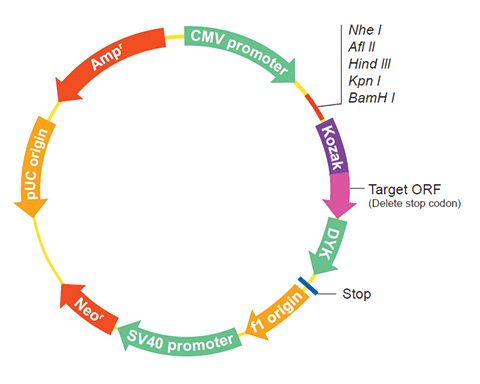
The following PPARA gene cDNA ORF clone sequences were retrieved from the NCBI Reference Sequence Database (RefSeq). These sequences represent the protein coding region of the PPARA cDNA ORF which is encoded by the open reading frame (ORF) sequence. ORF sequences can be delivered in our standard vector, pcDNA3.1+/C-(K)DYK or the vector of your choice as an expression/transfection-ready ORF clone. Not the clone you want? Click here to find your clone.
| CloneID | OSe28317 | |
| Clone ID Related Accession (Same CDS sequence) | NM_001044526.1 | |
| Accession Version | NM_001044526.1 Latest version! | Documents for ORF clone product in default vector |
| Sequence Information | ORF Nucleotide Sequence (Length: 1407bp) Protein sequence SNP |
|
| Vector | pcDNA3.1-C-(k)DYK or customized vector | User Manual |
| Clone information | Clone Map | MSDS |
| Tag on pcDNA3.1+/C-(K)DYK | C terminal DYKDDDDK tags | |
| ORF Insert Method | CloneEZ™ Seamless cloning technology | |
| Insert Structure | linear | |
| Update Date | 2018-09-15 | |
| Organism | Sus scrofa(pig) | |
| Product | peroxisome proliferator-activated receptor alpha | |
| Comment | Comment: PROVISIONAL REFSEQ: This record has not yet been subject to final NCBI review. The reference sequence was derived from DQ437887.1. ##Evidence-Data-START## Transcript exon combination :: DQ437887.1 [ECO:0000332] RNAseq introns :: single sample supports all introns SAMEA1876824, SAMEA1969720 [ECO:0000348] ##Evidence-Data-END## | |
1 | ATGGTGGACA CGGAAAGCCC CATCTGTCCC CTGTCCCCAC TGGAGGCCGA CGACCTGGAA |
The stop codons will be deleted if pcDNA3.1+/C-(K)DYK vector is selected.
| RefSeq | NP_001037991.1 |
| CDS | 42..1448 |
| Translation |
Target ORF information:
|
NM_001044526.1 |
1 | ATGGTGGACA CGGAAAGCCC CATCTGTCCC CTGTCCCCAC TGGAGGCCGA CGACCTGGAA |
The stop codons will be deleted if pcDNA3.1+/C-(K)DYK vector is selected.
Polymorphism in 3' untranslated region of the pig PPARA gene influences its transcript level and is associated with adipose tissue accumulation. |
The quantitative expression of peroxisome proliferator activated receptor (PPAR) genes in porcine endometrium through the estrous cycle and early pregnancy. |
Gender and genetic differences in bladder smooth muscle PPAR mRNA in a porcine model of the metabolic syndrome. |
Cytogenetic mapping of DGAT1, PPARA, ADIPOR1 and CREB genes in the pig. |