




































リコンビナントタンパク質_精製したリコンビナントタンパク質 » Enterokinase (EK), His, Lyophilized, Bovine
Enterokinase (EK), His, Lyophilized, Bovine

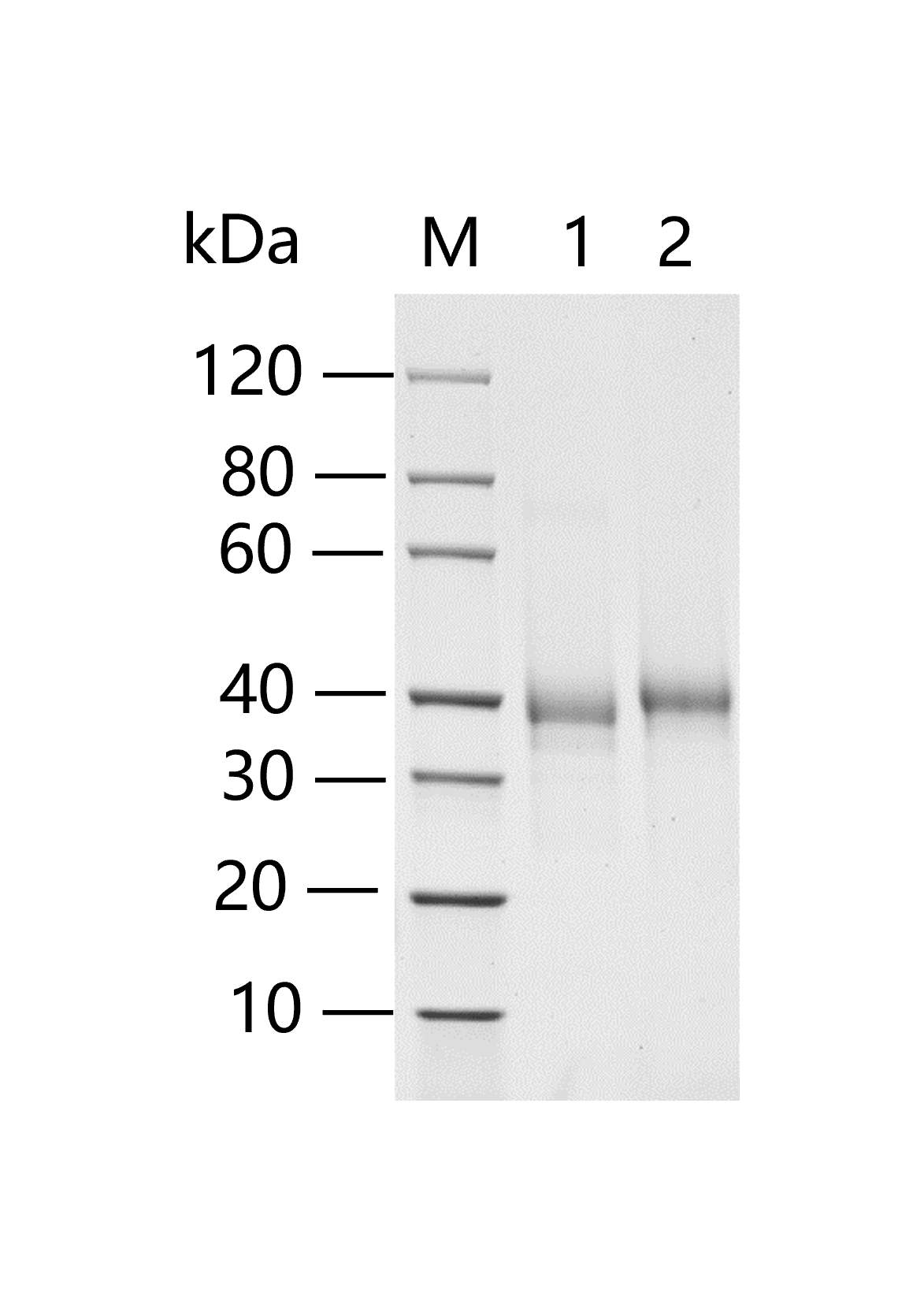
Lane 1: 2 μg of Enterokinase (EK), His, Lyophilized, Bovine, reducing (R)
Lane 2: 2 μg of Enterokinase (EK), His, Lyophilized, Bovine, non-reducing (NR)
> 95% as analyzed by SDS-PAGE

Enterokinase (EK), His, Lyophilized, Bovine

Enterokinase (EK) is an enzyme produced by cells of the duodenum and involved in human digestion. It plays a role of turning trypsinogen to its active form trypsin, and indirectly activates the pancreatic digestive enzymes. Enterokinase is a specific protease that cleaves after a lysine preceded by four aspartic acids: Asp-Asp-Asp-Asp-Lys(DDDDK↑). Enterokinase will not work if the recognition site is followed by a proline. rbEKhas the highest activity than EK of other species and is used wildly in biochemical applications. rbEK with 6 × His-tag binds with Ni2+ affinity chromatography and was designed to be removed from digestion system. Recombinant Bovine Enterokinase (His-tagged) (rbEK) as the light chain is a single glycosylated polypeptide chain containing 200 amino acids, 6 × His at C-terminus. A fully biologically active molecule, rbEK has a molecular mass of 40 kDa and is obtained by proprietary chromatographic techniques at GenScript.
Z03376
¥13,804.00

Ask us a question
Product Introduction
Source P. pastoris
Species Bovine
Purity > 95% as analyzed by SDS-PAGE.
Biological Activity 100 IU/μg
Unit Definition One unit is defined as the amount of enzyme needed to cleave 50 μg of fusion protein in 16 hours to 95% completion at 22°C in a buffer containing 25mM Tris-HCl, pH 8.0.
Endotoxin Level <0.2 EU/μg, determined by LAL method.
Molecular Weight 40 kDa, observed by reducing SDS-PAGE.
Reconstitution Reconstituted in sterile EK Storage Buffer (20mM Tris-HCl, pH 7.4, 200mM NaCl, 2mM CaCl2, 50% glycerol) at 0.1 mg/ml
Formulation Lyophilized from a 0.2 μm filtered solution in 20mM Tris-HCl, pH 7.4, 200mM NaCl, 2mM CaCl2.
Storage & Stability Lyophilized recombinant Bovine Enterokinase (His-tagged) (rbEK) remains stable for one year at -20°C from date of receipt. Please avoid freeze-thaw cycles.

Examples
  • Enterokinase (EK), His, Lyophilized, Bovine
  • Enterokinase (EK), His, Lyophilized, Bovine

    Lane 1: 2 μg of Enterokinase (EK), His, Lyophilized, Bovine, reducing (R)
    Lane 2: 2 μg of Enterokinase (EK), His, Lyophilized, Bovine, non-reducing (NR)
    > 95% as analyzed by SDS-PAGE


Background
Synonyms Enteropeptidase, ENTK, PRSS7
Target Background Enterokinase (EK) is an enzyme produced by cells of the duodenum and involved in human digestion. It plays a role of turning trypsinogen to its active form trypsin, and indirectly activates the pancreatic digestive enzymes. Enterokinase is a specific protease that cleaves after a lysine preceded by four aspartic acids: Asp-Asp-Asp-Asp-Lys(DDDDK↑). Enterokinase will not work if the recognition site is followed by a proline. rbEKhas the highest activity than EK of other species and is used wildly in biochemical applications. rbEK with 6 × His-tag binds with Ni2+ affinity chromatography and was designed for removing from digestion system.
Recombinant Bovine Enterokinase (His-tagged) (rbEK) as the light chain is a single glycosylatedpolypeptide chain containing 200 amino acids, 6 × His at C-terminus. A fully biologically active molecule, rbEK has a molecular mass of 40 kDa and is obtained by proprietary chromatographic tech- niques at GenScript.

For research use only. Not intended for human or animal clinical trials, therapeutic or diagnostic use.